



Sensory Overload: A Simple Definition
Sensory overload is a state in which the brain has difficulty processing too much sensory input at the same time. It may be triggered by loud sounds, bright light, touch, movement, smells, or several stimuli at once.
How does it work?
Under typical conditions, the brain prioritizes important sensory information and filters out what is unnecessary. This ability is called sensory regulation. It helps a child maintain an appropriate level of arousal, sustain attention, and adjust their pace of activity to the situation.
When there is too much sensory input or it is too intense:
- attention becomes scattered;
- managing emotions and behavior becomes more difficult;
- even a familiar task may temporarily feel unmanageable.
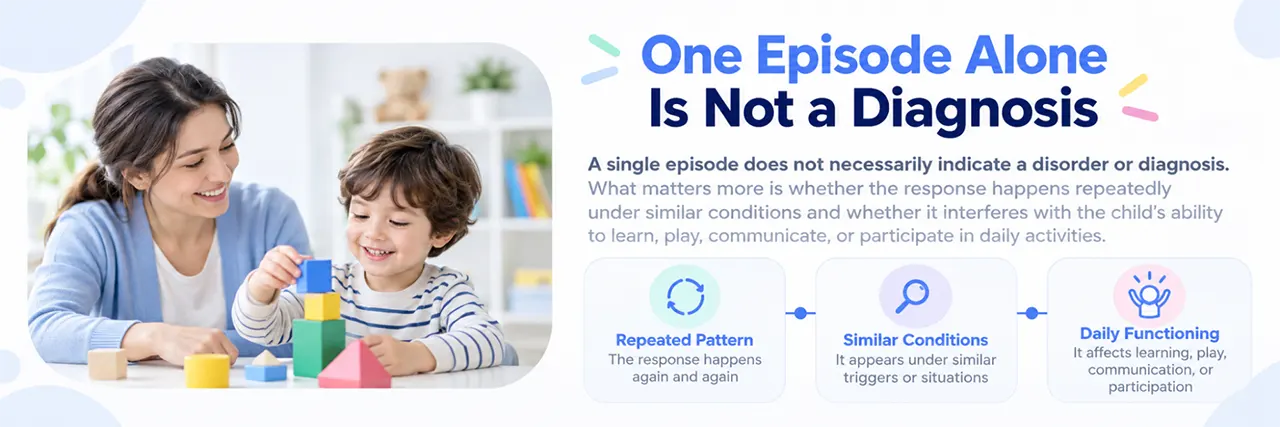
Hyper-Responsive and Hypo-Responsive Nervous Systems
Sensory processing difficulties can look very different. One child may try to avoid sensory input, while another actively seeks it.
| Hyper-responsiveness | Hypo-responsiveness | |
|---|---|---|
| How the brain perceives sensory input | Ordinary sounds, light, or movement feel too intense | Sensory input feels too weak or is registered with a delay |
| What it may look like | The child covers their ears, avoids touch and movement, asks for the lights to be turned off, or becomes tired more quickly | The child moves and jumps frequently, seeks pressure and intense sensations, and may respond more slowly when spoken to |
| What the nervous system is trying to do | Reduce the amount of sensory input | Seek more sensory input to reach an appropriate level of arousal |
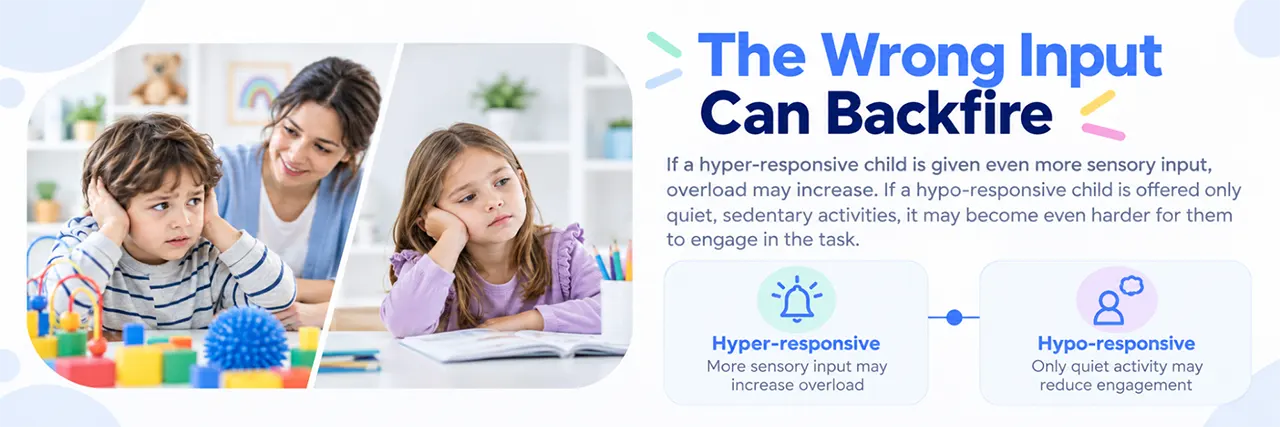
Signs of Over-Arousal: What Sensory Overload May Look Like
- noticeable irritability,
- anxiety,
- discomfort,
- an intense emotional reaction.
- trying to leave,
- refusing to continue the activity,
- avoiding a particular movement or environment.
- the child stops following instructions,
- becomes disengaged,
- responds with a delay.
- covers their ears,
- has greater difficulty tolerating background noise,
- avoids movement or becomes tired from it quickly.
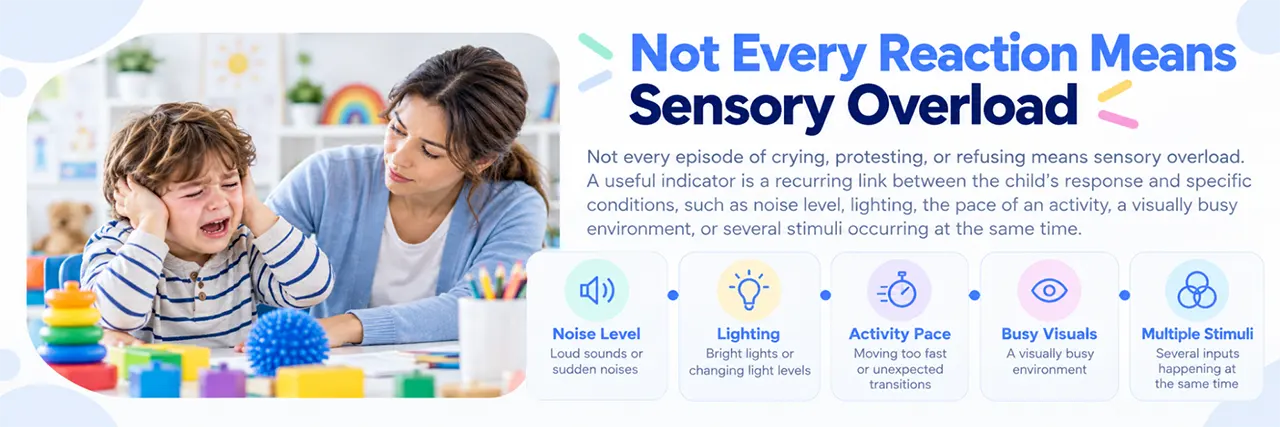
What Causes Sensory Overload
Sensory overload may be triggered by one intense stimulus or several moderate stimuli occurring at the same time.
- loud sounds and background noise;
- bright or flickering lights;
- many objects, people, or moving visual elements;
- unfamiliar smells or touch.
- a pace that is too fast;
- frequent changes in activities and directions;
- sound, visual input, and physical activity occurring at the same time;
- the need to transition quickly to a new task.
- verbal instructions in a noisy classroom;
- finding a target object among many visual details;
- completing a task near other active children.
A child’s response depends not only on the type of stimulus, but also on its intensity, duration, and combination with other sensory input. That is why it is useful to observe not only the child’s behavior, but also what happened immediately before the response.
- Where and under what conditions the response occurred.
- Which sounds, movements, lights, or activities may have intensified it.
- How the child responded.
- What helped and how long it took the child to return to the activity.
This makes it easier to identify recurring triggers and understand which support strategies are actually effective.
How to Help a Child During Sensory Overload
Sensory overload can happen anywhere: at school, in a store, on public transportation, while visiting others, or at home. The adult’s main goal is not to make the child behave “correctly,” but to reduce sensory input and give the nervous system time to recover.
Move to a quieter place. If possible, move away from the crowd, leave a noisy room, or find a space with dim lighting.
Reduce sensory input. Turn off music, remove bright screens, limit conversation, and ask others to give the child more personal space.
Temporarily reduce demands. Do not ask the child to calm down immediately, explain their behavior, maintain eye contact, or continue the activity they were doing.
Keep your language brief and predictable. Instead of asking several questions, give one clear instruction: “Let’s move somewhere quiet” or “I’ll stay here with you.” Let the child know in advance what you are going to do.
Offer a familiar support strategy. This may include headphones, a favorite object, a hood, water, or a chance to sit quietly. Do not insist: it is important for the child to be able to accept or decline help.
Allow time to recover. The response may continue even after the triggering input is removed. Stay nearby if the child is comfortable with that, and return to conversation or regular activities only after they are more regulated.
Expert insight:
A quiet, predictable environment reduces the amount of sensory input the brain must process at the same time.
A calm rhythm, soft music, or nature sounds can also be part of this environment if the child tolerates them well. Their purpose is not to “treat” sensory overload, but to create conditions that make it easier for the nervous system to return to a regulated state.
When Professional Support May Be Needed
Consider consulting a professional when sensory responses are recurring and noticeably interfere with the child’s daily life. For example, the child:
- avoids school, stores, public transportation, or other noisy places;
- is unable to participate in lessons or group activities;
- has difficulty dressing, washing, or eating because of sounds, smells, or textures;
- frequently has to stop everyday activities and takes a long time to recover after sensory overload;
- needs substantial adult support even in familiar situations;
- misses family activities, outings, or time with peers because of sensory overload.
Who to See: A Pediatrician or an Occupational Therapist
A pediatrician is a good first point of contact when the cause of the child’s responses is unclear. They can evaluate the child’s overall health and development and determine whether the difficulties may be related to hearing, vision, sleep, pain, or another condition. If needed, the pediatrician may refer the child to an occupational therapist, neurologist, psychologist, or another specialist.
A pediatric occupational therapist evaluates how sensory differences affect the child’s daily life. They observe how the child plays, learns, dresses, eats, and responds to different environments. The therapist also works to help prevent sensory overload by:
- identifying triggers,
- selecting appropriate support strategies,
- gradually carrying these strategies over into everyday life.
This is addressed through structured therapy sessions. The goal is not simply to provide more movement or sensory input, but to help the child reach a regulated state in which it is easier to communicate, play, learn, and participate in everyday activities.
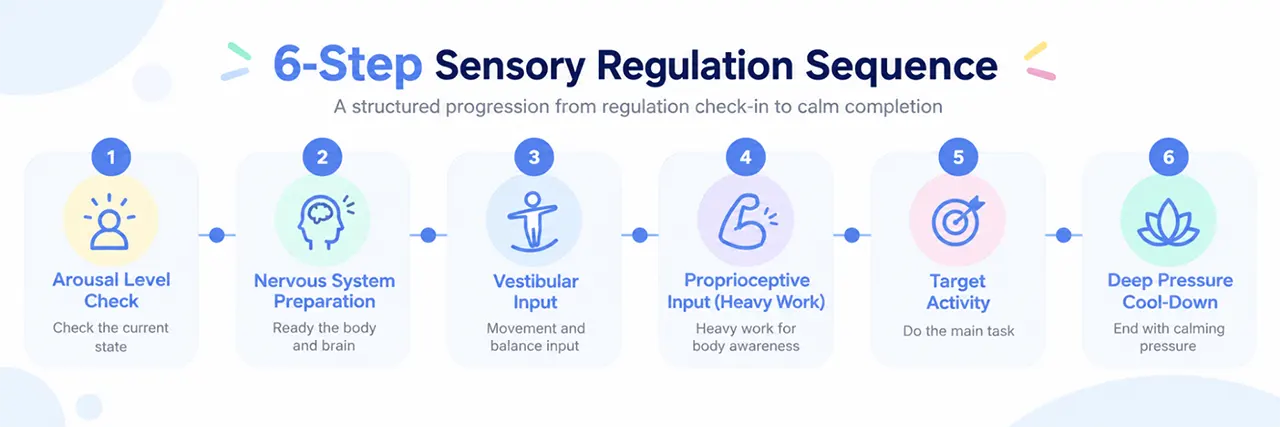
What a Therapy Session May Look Like
Assess the child’s state. The therapist determines whether the child is over-aroused, under-aroused, or ready to engage.
Select the appropriate sensory input. One child may need a calm activity with minimal sound and movement, while another may benefit from a more active task.
Observe the child’s response. The therapist adjusts the pace, duration, and difficulty of the activity if the child becomes tired, loses attention, or begins to avoid the activity.
Move on to a functional task. Once the child is more regulated, they complete an activity that is meaningful in daily life, such as following instructions, waiting their turn, communicating, participating in learning, or practicing a self-care skill.
End the session calmly. The intensity is gradually reduced to help the child transition more easily to the next activity.
The content of the session depends on which types of sensory input the child avoids or seeks and which everyday tasks are difficult for them.
How NeuroLevel Supports Sensory Regulation
NeuroLevel equipment can be incorporated into structured sessions focused on sensory regulation, motor activity, attention, and the child’s participation in shared activities.
The interactive system allows the therapist to adjust several parameters:
- choose calming or more active games;
- adjust the amount of movement;
- reduce or increase visual complexity;
- select appropriate auditory input;
- change the difficulty and duration of the task;
- immediately observe how the child responds to the selected input.
For example, a hyper-responsive child may do better with a calm, slow-paced game that uses simple visuals and minimal sound. If a child has difficulty becoming alert and engaged, the therapist can choose a task with more active movement and clear, immediate feedback.
Mechanisms We Use
Vestibular Input – Movement and Balance
Active movement can increase arousal, while slow, predictable movement allows vestibular input to be graded for children who are sensitive to movement.
With NeuroLevel, this type of input is provided when a child moves across the interactive floor, changes direction, visually tracks a moving object, or follows a route on the climbing wall.
- choose calming or more active games;
- adjust the amount of movement;
- reduce or increase visual complexity;
- select appropriate auditory input;
- change the difficulty and duration of the task;
- immediately observe how the child responds to the selected input.


Proprioceptive Input – Body Awareness
Proprioception provides the brain with information from the muscles and joints. It helps the child understand where their body is in space, modulate force, and control movement more accurately.
Stepping, jumping, and shifting body weight provide clear proprioceptive input through the muscles and joints. For some children, this improves body awareness and helps them return to a more regulated state.
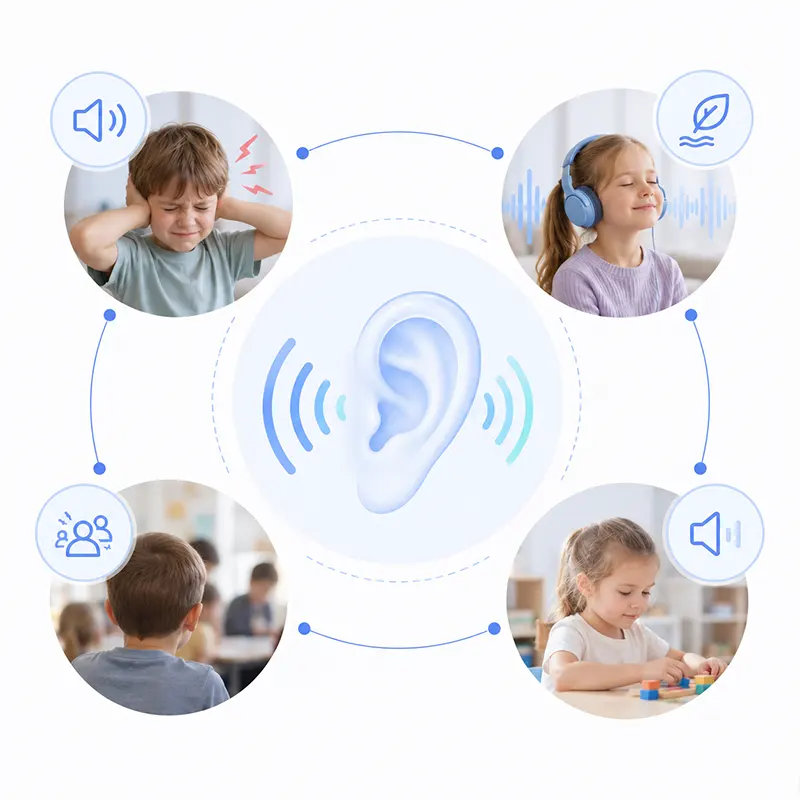
Auditory Input – Processing and Filtering Sounds
During auditory overload, a child may have difficulty filtering background noise and focusing on relevant sounds. The therapist may therefore choose a game with quiet auditory input and minimal motor demands.
Calming nature sounds can also be used to create a less intense auditory environment.
Visual and Tactile Input
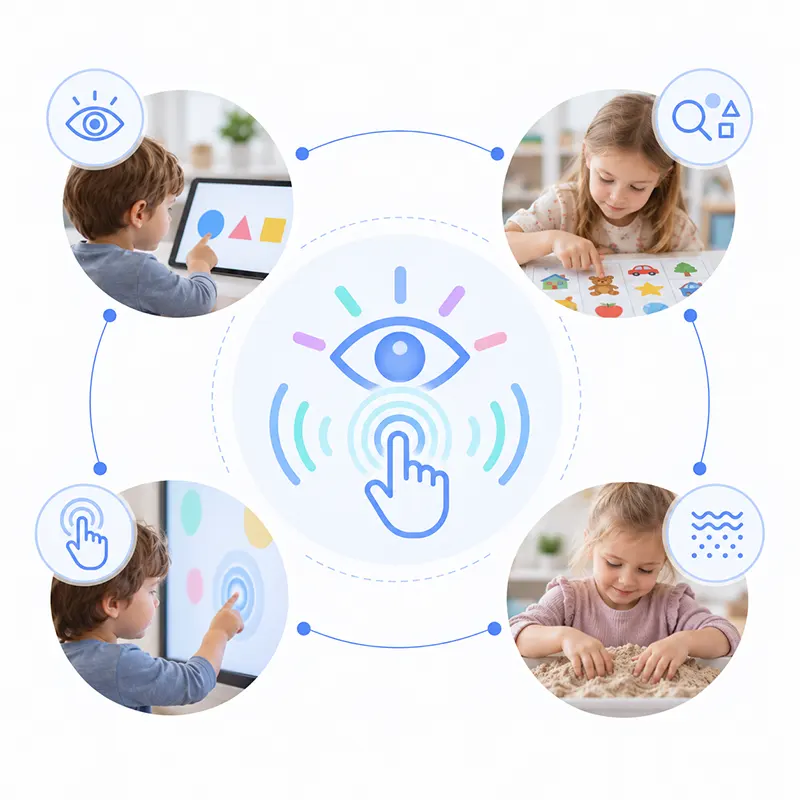
Simple visual scenes reduce the amount of visual input the brain needs to process, while visual-search activities help the child learn to identify relevant objects among distracting details.
Touching the screen, wall, or sand provides clear feedback. This graded input can help the child respond more effectively to visual and tactile stimuli.
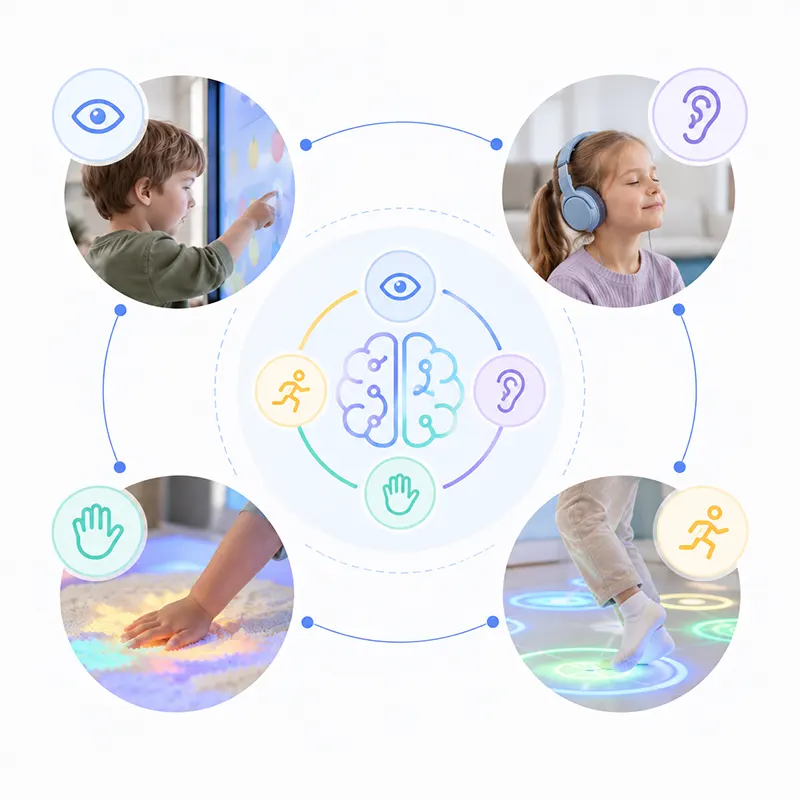
Multisensory Integration
NeuroLevel software provides immediate feedback (touch or step – and the child instantly sees and hears the result), making the environment more predictable and reducing the effort required to filter out unpredictable sensory input.
Goal-Directed Play and Motor Planning
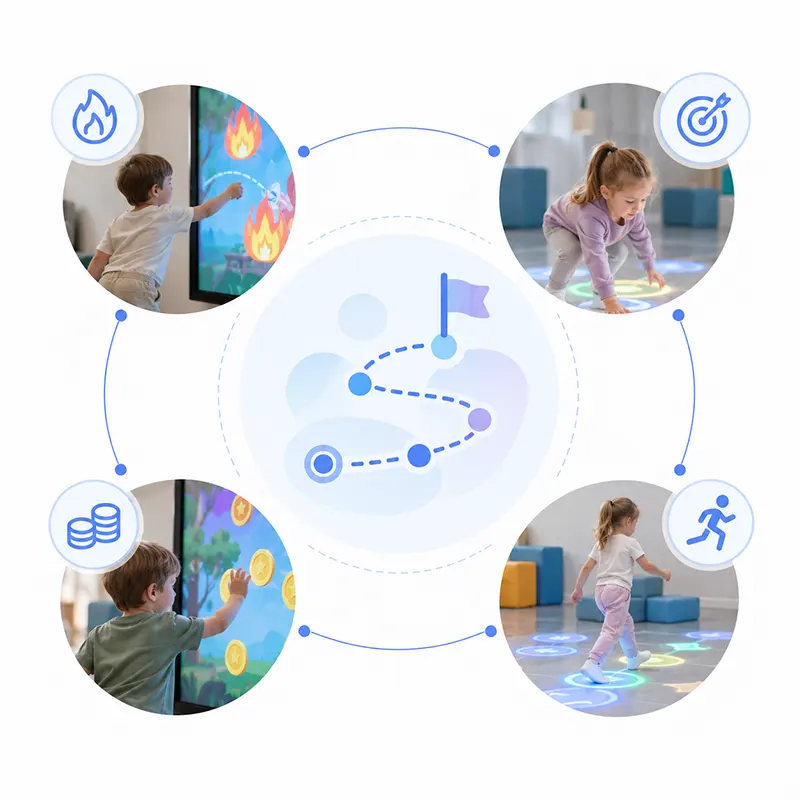
Unstructured, chaotic activity can increase nervous-system over-arousal. NeuroLevel scenarios use goal-directed play, such as putting out a fire, collecting coins, or completing a route.
When the child’s brain focuses on carrying out a specific motor plan, it can filter out external distractions more efficiently. This can reduce sensory overload, support regulation of the nervous system, and help the child sustain attention to the task.
NeuroLevel Equipment
- Allows the therapist to select calming or active games to lower or raise the child’s level of arousal.
- Provides goal-directed whole-body input. A visual route makes movement more organized and predictable.
- Allows the therapist to work with visual and auditory input without requiring intensive movement around the room.
- Supports calm activities with a controlled amount of sensory input and helps the child focus on one sequential task.
- The weight and texture of the sand provide deep-pressure input, which can help reduce the fight-or-flight response and tactile defensiveness. At the same time, the projection’s immediate visual feedback makes interactions more predictable, helping the child develop a motor plan and feel secure.
- Allows the child to begin with a calm creative activity and gradually transition to interacting with a moving image.
The NeuroLevel product line allows therapists to precisely grade sensory input, from active whole-body activities to calm visual and tactile tasks.
The therapist selects the format based on the child’s current state, the setting, and the intended outcome. For example, the equipment can be used:
- at school – to help the child return to class,
- in a therapy center – to develop sensory-regulation skills,
- at home – to continue practice between therapy sessions.
How to Track Progress in Sensory Regulation
The goal is not to eliminate every episode of sensory overload, but to help the child recognize changes in their state earlier and use appropriate support strategies more independently. Signs of progress may include:
- the child asks for a break or a calmer activity before becoming overwhelmed;
- independently uses headphones or moves to a quiet area;
- returns to the task more quickly after a regulating activity;
- sustains attention for longer;
- needs instructions repeated less often.
Choose one measurable indicator to track
This may be the amount of time the child stays engaged in a task, the number of times an instruction must be repeated, or the number of times the child independently requests support. Compare the child’s results with their own previous performance, not with other children.Frequently Asked Questions About Sensory Overload
-
How is sensory overload different from ordinary fatigue?
When a child is tired, rest usually helps regardless of the environment.
With sensory overload, the response is often linked to specific conditions, such as noise, bright light, touch, or several stimuli occurring together. The two can overlap: a tired child may have more difficulty managing sensory input.
-
Why can the same stimulus cause a different response on different days?
A child’s capacity to handle sensory input can vary. It may be affected by fatigue, hunger, illness, emotional stress, the duration of an activity, and the amount of sensory input the child has already experienced that day. That is why it is important to consider not only a specific sound or movement, but also the child’s overall state.
-
Should all sensory stimuli be completely eliminated?
Not always. During sensory overload, reducing input can help the child recover.
Long-term strategies should be tailored to the child’s needs. Sometimes the environment is adapted; in other cases, the child gradually learns to use supports and participate in necessary everyday situations. Sensory demands should not be increased abruptly without a plan developed by a professional.
-
What information is helpful to share with a teacher or occupational therapist?
Describe the specific situation: where it happened, what sensory input was present, how the child responded, how long recovery took, and what helped.
This is more useful than a general statement such as “the child often gets overstimulated,” because it helps identify patterns and evaluate support strategies.
Choose the Right NeuroLevel System for Your Needs
Not sure which system is right for you? The choice depends not only on your goals, but also on room size, lighting, installation method, and session format.
During a consultation, the NeuroLevel team evaluates these factors and recommends a configuration that can be fully integrated into daily practice.
